Book
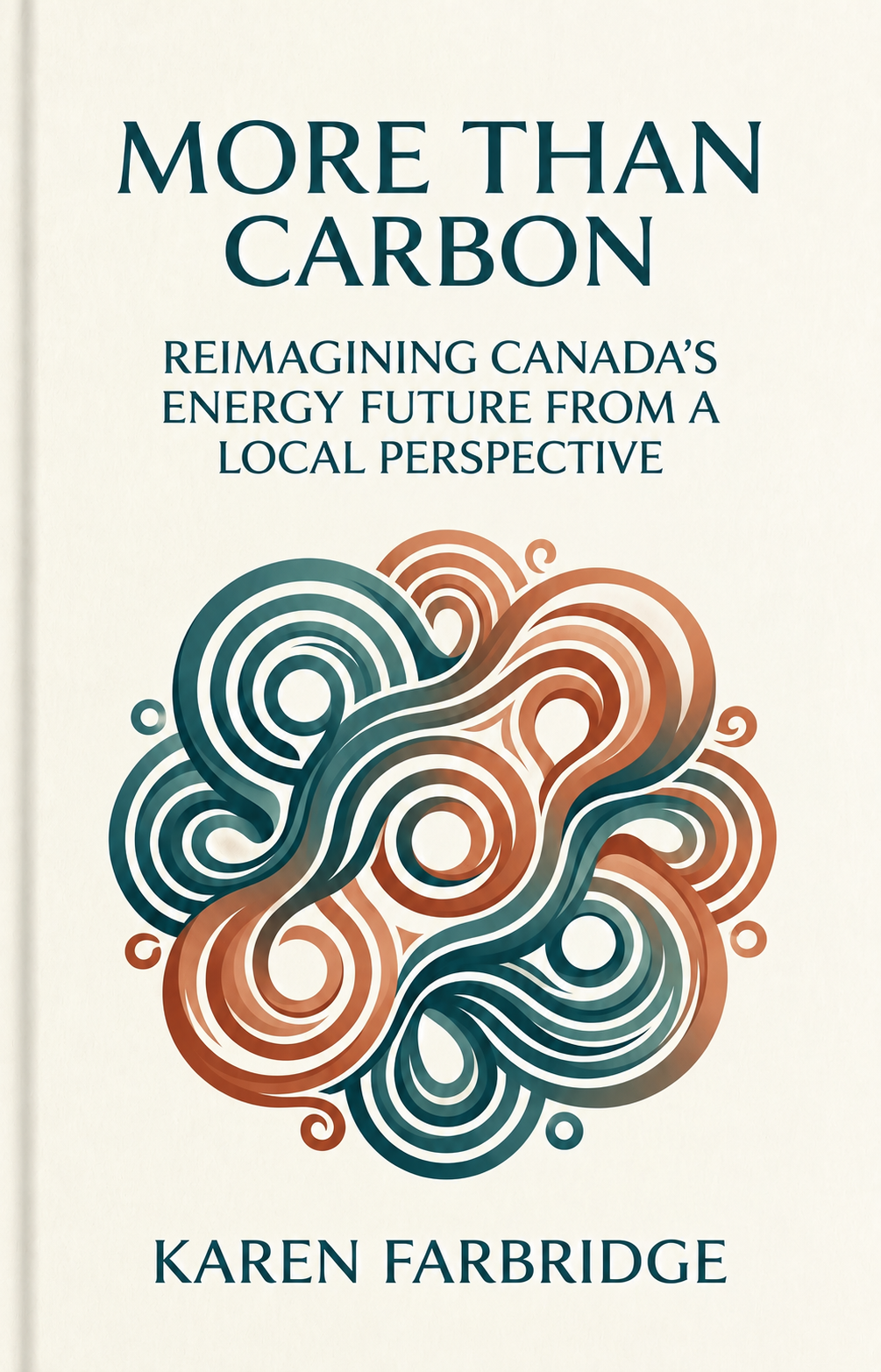
More Than Carbon: Reimagining Canada’s Energy Future from a Local Perspective
Canada’s energy transition will be won or lost in its communities – not in Ottawa, and not in the oil sands. Traditional climate planning has left municipal leaders with passive emissions targets and unwieldy plans that fail to drive real systems change. More Than Carbon gives municipal leaders the grounding – and the framework – to build something genuinely different.
By Karen Farbridge, PhD
Former Mayor of Guelph & 30-year municipal leadership practitioner · Publishing early 2027
Reserve your copy
Sign up to receive early chapter excerpts, book reviews and publication alerts.
The Argument
A single-minded focus on emissions is a mistake.
Without a deeper shift in mindset, Canada risks rebuilding the same extractive energy system under a greener banner, rather than creating something genuinely different.
This is a call to reimagine Canada’s energy future as a cultural and moral transition, not a purely technological one. It’s a move toward a system that is more just, resilient, and regenerative.
The Core Thesis
Cutting emissions is necessary but insufficient.
A genuinely sustainable energy system must reckon with four imperatives.
One
Ecological Integrity — There is no “clean” energy.
Mining the minerals required for low-carbon technologies creates severe environmental and social harms. We must protect broader living systems, not just count carbon.
Two
Energy Efficiency, Security & Resilience — Waste less, protect communities.
Over half of Canada's energy is wasted before doing useful work. With rising prices leaving 14% of Canadian households in energy poverty, local energy efficiency and independence ensure essential services survive systemic shocks.
Three
Energy Justice — Fairly distribute harms and benefits.
Canada's energy history carries a colonial legacy that has disproportionately harmed indigenous peoples and vulnerable communities. A true transition rectifies who bears the costs and who reaps the rewards.
Four
Energy Democracy & Sovereignty — Shift power back to local hands.
Decentralized production, local co-op ownership, and indigenous self-determination give communities real control over their energy futures.
“These aren’t side issues. They determine whether our urgently needed energy transition actually succeeds.”
What the Book Does
The book was written for people who have to act.
- It gives communities an energy planning compass.
- Advocates for a new energy era built on regenerative, circular-economy principles.
- Grounds climate action in sound energy policy that protects communities.
- Provides Canadian examples and models ready to adapt.
Inside the Book
Three parts: Attention. Intention. Agency.
Part One · On Attention
The Mindset Shift
The history of energy regimes, planetary boundaries, and how Canada reached this crisis point.
Part Two · On Intention
The Circular Framework
A place-based practice of community energy planning built around four strategic moves: Reduce, Improve, Switch, and Regenerate.
Part Three · On Agency
Real-World Practice
Actionable Canadian case studies across six sectors: Land-Use Planning, Buildings, Mobility, Prosumer Power, Thermal Utilities, and Municipal Services.
Institutional & Academic Adoption
The book is already core course material.
More Than Carbon serves as core course material for York University’s Sustainable Energy Initiative community energy micro-credit.
Desk Copies & Curriculum Integration
Request an advance sample chapter or desk copy for university and college courses.
Bulk Municipal Orders
Special pricing and workshop packaging available for municipal staff, council cohorts, and climate action teams.
Institutional Inquiries
Contact us to arrange bulk distribution or co-designed training sessions.
Coming early 2027.
Sign up to receive early chapter excerpts, book reviews and publication alerts.